Managed IT Services for Law Firms: Protecting Attorney-Client Privilege in Kansas City
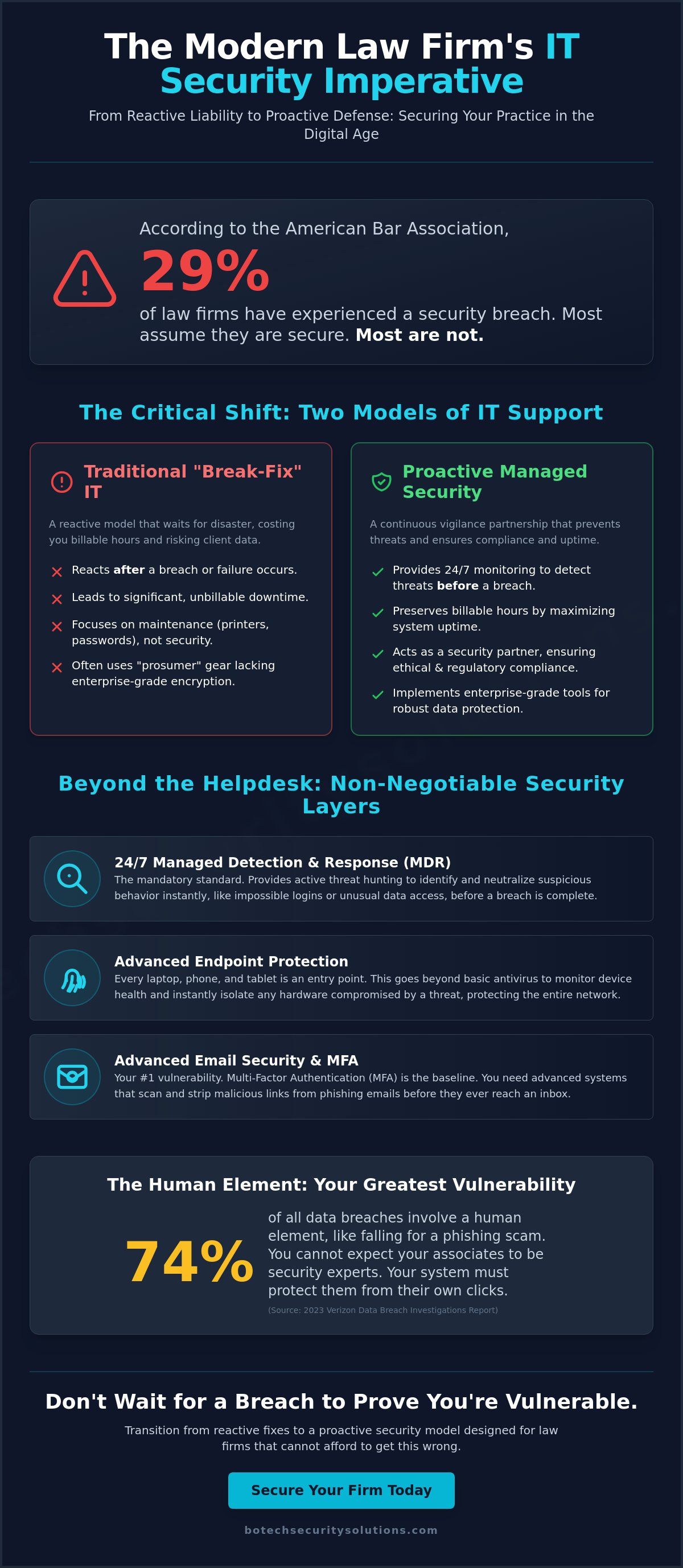
Most Kansas City law firms assume their current IT setup is secure until a breach proves otherwise. According to the American Bar Association 2023 Legal Technology Survey Report, 29% of law firms have experienced a security breach at some point. Most believe they are protected. Most are not. Relying on basic tech support isn't enough when attorney-client privilege is on the line. You need managed it services for law firms that understand the weight of your ethical obligations and the reality for organizations that cannot afford to get this wrong.
You're likely frustrated with IT vendors who don't respect the urgency of billable hours or the complexity of compliance requirements like SOC 2. It's exhausting to manage sensitive discovery data while worrying if your backup system actually works. We're going to show you how to transition from reactive fixes to a proactive security model. You'll learn how to secure your firm's billable hours and sensitive data with enterprise-grade IT protection at a price a local firm can afford.
We'll break down the specific technical safeguards required to protect your reputation and ensure zero downtime during critical trial phases.
Key Takeaways
- Learn why the outdated break-fix model is a liability and how proactive technology management preserves your firm's billable hours.
- Understand why 24/7 Managed Detection and Response (MDR) has become a mandatory requirement for protecting sensitive discovery data.
- Discover how to evaluate managed it services for law firms using a security-first framework that distinguishes true protection from simple helpdesk support.
- Identify the specific regional cyber threats targeting Kansas City legal hubs and the tactical advantage of local, on-site technical expertise.
- Recognize the "uncomfortable truth" about standard IT providers and why firms that cannot afford to get this wrong need a dedicated security ally.
What Are Managed IT Services for Law Firms in 2026?
Your law firm is currently being scanned by automated threat actors. This is not a hypothetical scenario. In 2026, law firms have become primary targets for sophisticated ransomware because they hold high-value data with often-outdated security. Many partners believe their current setup is "fine" because they haven't crashed yet. Most are not actually protected.
The Managed IT services model has evolved into a continuous vigilance partnership. It replaces the obsolete break-fix approach where you only call for help after the screen goes dark. For managed it services for law firms, the goal is to maintain a posture that is always audit-ready. This is no longer optional. ABA Model Rule 1.1 Comment 8 explicitly requires lawyers to keep abreast of the benefits and risks associated with relevant technology. Failure to secure your environment is now a failure of professional competence.
The Core Pillars of Legal IT Support
Modern legal IT requires infrastructure that handles the heavy lifting of SOC 2 or HIPAA compliance without slowing down your associates. Your network must be configured so that every login and data transfer creates a verifiable trail. This ensures you are prepared for the strict disclosure requirements of 2026. Integration is the second pillar. Your managed partner must ensure that practice management tools like Clio, MyCase, or Smokeball sync perfectly with your local hardware and encrypted cloud backups.
Managed IT is the strategic backbone that ensures a firm remains operational, secure, and ethically compliant at all times.
This commitment to professional excellence extends to every tool a firm uses to ensure integrity. For those requiring specialized investigative verification or professional polygraph services, you can visit Morgan Polygraph to see how these experts support legal discovery.
Why Traditional IT is a Liability
There is a dangerous difference between a general IT guy and a Managed Security Service Provider. An IT guy fixes a broken printer. An MSSP prevents a breach that could end your practice. Waiting for technology to break is a catastrophic strategy for billable hours. If your server goes down on a Friday night, a traditional technician might see your call on Monday morning. By then, your firm has lost tens of thousands in unbillable time and potentially leaked sensitive client discovery.
Organizations That Cannot Afford to Get This Wrong understand that 24/7 monitoring is the only way to catch weekend or holiday breaches. The uncomfortable truth is that most small to mid-sized law firms are using "prosumer" gear that lacks enterprise-grade encryption. You are either protected by a proactive system or you are waiting for an inevitable disaster. There is no middle ground in 2026.
Beyond the Helpdesk: Security Features You Cannot Ignore
Your staff works from courtrooms, home offices, and coffee shops. Every laptop and mobile device is a potential entry point for a breach. Endpoint protection must guard every device accessing client files. This is a non-negotiable component of managed it services for law firms. Most vendors install antivirus and walk away. We know that is not enough. You need a system that monitors device health and isolates infected hardware the moment a threat is detected.
Email is your greatest vulnerability. Phishing attempts are becoming indistinguishable from legitimate court correspondence. Multi-Factor Authentication (MFA) is your first line of defense, but it is just the floor. You need advanced email security that strips malicious links before they reach an attorney’s inbox. According to the 2023 Verizon Data Breach Investigations Report, 74% of breaches involve a human element. You cannot expect your associates to be security experts, so you must build a system that protects them from their own clicks.
Consider a common scenario. A senior partner receives an email that appears to be a discovery request. They click a link and accidentally share their credentials. Without MDR and endpoint monitoring, a hacker can sit in your network for months. They watch your emails and learn your billing patterns. This creates massive legal and financial liabilities that standard malpractice insurance may not cover. An uncomfortable truth most vendors avoid is that software alone is useless. Security requires human experts watching the logs every hour of every day.
Protecting Sensitive Discovery Data
Encryption is the baseline for protecting discovery. You must use AES-256 standards for data at rest and TLS 1.3 for data in transit. MDR technology is critical here because it identifies lateral movement. If a hacker gains access to a receptionist's computer, MDR stops them before they jump to the server containing sensitive litigation files. Dark web monitoring is also essential. It alerts us the moment an attorney’s credentials appear on underground forums, allowing us to rotate keys before a breach occurs.
Compliance Management: Program vs. Document
There is a dangerous myth that a compliance manual makes you compliant. Most are not. A stack of papers in a desk drawer is just a document. A true compliance program generates ongoing evidence of security. If your firm handles HIPAA-regulated evidence in personal injury cases, you must follow Section 164.308 of the Security Rule. This requires automated evidence collection. You need to prove you were compliant at any given moment, not just during an annual review. One partner should handle both your security and your compliance to ensure no gaps exist between your policy and your technical reality.
To start securing your firm today, audit your MFA settings. Ensure it is required for every single application, including your practice management software and email. You can find out where you actually stand by reviewing your current security logs for unauthorized access attempts.
Evaluating Providers: The Security-First Comparison Framework
Law firms often realize too late that their IT provider is a generalist when they actually needed a specialist. A standard Managed Service Provider (MSP) keeps your email running and your laptops updated. This is not enough for organizations that cannot afford to get this wrong. A security-focused Managed Security Service Provider (MSSP) treats every connection as a potential breach point. When selecting managed it services for law firms, you need one partner that can consolidate security and compliance. You must look for a partner that prioritizes defense over simple convenience.
The uncomfortable truth most vendors avoid is that their "standard" security package is often just a collection of software licenses with no active management. If your provider cannot give you a specific time to remediation for a ransomware event, they don't have a plan. They have a hope. You should look for providers that follow established cybersecurity best practices for law firms to ensure they understand the nuances of attorney-client privilege. Vague promises about being "secure" or hidden fees for "emergency" support are major red flags. Real security requires a flat-rate model because hourly billing incentivizes your provider to profit from your technical failures. If they haven't worked with firms subject to ABA Model Rule 1.6, they aren't equipped to protect your reputation.
The Security-First Checklist for Partners
Most firms assume their IT team is watching the gates at 3:00 AM on a Sunday. Most are not. You need 24/7/365 monitoring that identifies anomalies while your staff sleeps. Your provider must also include security awareness training for every employee to fix the human link. Human error caused 82 percent of data breaches in 2022 according to the Verizon Data Breach Investigations Report. Finally, verify they have dedicated security leadership, such as a CISO, rather than just a lead technician who handles security on the side.
Understanding the ROI of Proactive Support
Proactive support is a business investment, not a technical expense. IBM's 2023 Cost of a Data Breach Report found that the average cost of a breach reached $4.45 million. Comparing that to a predictable monthly service fee makes the decision clear. A robust IT posture can also lower professional liability insurance premiums by 10 to 15 percent. Consider the cost of your entire staff sitting idle for three days while you wait for a backup to restore. It is far cheaper to fund a comprehensive compliance program that generates ongoing evidence than it is to settle a malpractice suit following a data leak.
Local Vigilance: Managed IT Services in Kansas City
Most firms believe their cloud provider handles every contingency until a local server goes dark on a Friday afternoon before a Jackson County filing deadline. Remote support from a technician in a different time zone provides zero relief when a physical network switch fails in your server closet. You need a partner who can be in your office in Lee’s Summit or Olathe within the hour. Effective managed it services for law firms require a physical presence because hardware failures do not happen in the cloud. They happen in your office, and they require immediate, local intervention.
The uncomfortable truth most vendors avoid is that remote-only support models are designed for the provider's profit, not your firm's protection. When your billable hours are on the line, an automated ticket response is a liability. We focus on the Kansas City metro because we understand that regional threats specifically target Midwest legal and financial hubs. Cybercriminals often pivot their tactics based on local court schedules and regional business cycles. We monitor these patterns in real time to ensure our clients are not the next headline in the Kansas City Business Journal.
KC Legal Community Requirements
Navigating the dual requirements of Missouri Revised Statutes Section 407.1500 and Kansas Statutes Section 50-7a02 is a full-time job. By 2026, these data breach notification laws have become more stringent, requiring specific forensic evidence of "reasonable security" to avoid massive civil penalties. Local firms often assume they are too small to be targeted. Most are not. We provide enterprise-grade security services that allow a five-person firm in Overland Park to maintain the same compliance posture as a national entity. We bridge the gap between high-end protection and a small business budget.
BoTech’s Local Impact and Expertise
We recently intercepted a sophisticated spear-phishing campaign targeting a mid-sized firm in downtown Kansas City. The attackers used spoofed email headers to mimic a local court clerk, a tactic designed to exploit the fast-paced nature of a litigation practice. Our team identified the anomaly within 120 seconds. This level of vigilance is only possible when your partner understands the local landscape. Our boots on the ground approach to vulnerability assessments ensures that we see the physical security gaps that a remote scanner would miss.
As a veteran-owned business, we operate with a disciplined, mission-focused mindset. We view ourselves as a strategic ally for organizations that cannot afford to get this wrong. Our approach is built on the principle that a compliance program generates ongoing evidence, whereas a compliance document is just a piece of paper. We don't just manage your IT; we defend your practice. This commitment to the KC metro is personal for us. We live here, we work here, and we take ownership of your firm’s safety as if it were our own.
Immediate Action Step: Review your current IT service agreement for a physical on-site response guarantee. If your provider does not commit to a specific arrival time for critical hardware failures, your firm is currently operating without a safety net.
Contact us today to find out where you actually stand with a comprehensive assessment of your local infrastructure.
BoTech Security Solutions: Your Strategic Ally in Legal IT
Your firm handles the most sensitive data in the Kansas City legal market. You are a high-value target for threat actors who understand the leverage inherent in attorney-client privilege. This is why we partner with organizations that cannot afford to get this wrong. Our approach to managed it services for law firms is built on a fundamental shift in perspective. Most providers are IT generalists who attempt to bolt on security after the fact. BoTech Security Solutions consists of security experts who handle IT. We lead with defense because uptime means nothing if your data is exfiltrated.
Predictability is essential for a well-run practice. Our BoTech Security Solutions Services operate on a flat-rate monthly model. You'll never see a surprise bill for an emergency response or a compliance update. This model aligns our interests with yours. We're incentivized to keep your environment secure and stable, rather than profiting from your technical failures. It's enterprise-grade protection delivered at a price point that makes sense for a growing firm.
Our Managed Security Service Model
We don't treat security as an optional upgrade. We standardize 24/7 Managed Detection and Response (MDR) and advanced Endpoint Protection for every legal client we serve. According to the 2024 IBM Cost of a Data Breach Report, the average cost of a breach has climbed to $4.88 million. A small firm cannot survive that impact. We provide the same level of vigilance used by global corporations to ensure your firm remains operational and reputable.
Compliance is a daily discipline, not a yearly event. We provide continuous monitoring for standards including HIPAA, SOC 2, and PCI DSS. We specifically focus on the HIPAA Security Rule under 45 CFR § 164.308, which requires administrative safeguards to protect electronic protected health information. Here's an uncomfortable truth: most vendors provide you with a compliance document that sits in a binder. We build a compliance program that generates ongoing evidence. A document proves you had a plan once; a program proves you're following it today.
Technology alone is insufficient. We include security awareness training to educate your staff on the nuances of phishing and social engineering. Most breaches start with a single human error. We ensure your team knows how to spot the red flags before a malicious link is clicked. This is a critical component of managed it services for law firms that prioritize long-term viability.
Take the Next Step Toward Firm Security
The transition from reactive chaos to proactive, managed calm begins with an initial consultation and a comprehensive network security audit. We don't make assumptions about your current state. We use forensic tools to identify exactly where your vulnerabilities lie and how to close them. This is about moving your firm into a state of organized stability where technology supports your billable hours instead of draining them.
You can take one specific action right now to gauge your risk. Log into your Microsoft 365 or Google Workspace admin console and review the sign-in logs for the last 24 hours. Filter for failures and look at the location data. If you see dozens of failed login attempts from countries where you don't have clients or staff, your firm is being actively probed. Most are not prepared for what happens when one of those attempts succeeds.
Don't wait for a ransom note to discover your vulnerabilities. Schedule your Kansas City firm’s security assessment today to find out where you actually stand. It's time to secure your legacy and your clients' trust with a partner who understands the stakes.
Secure Your Privilege Before the Next Breach
Attorney-client privilege is only as strong as the encryption and protocols guarding your digital files. Most Kansas City firms assume their current setup is sufficient until a SOC 2 audit or a breach proves otherwise. You can't afford to treat security as an afterthought or a simple helpdesk ticket. Effective managed it services for law firms must move beyond basic support to include 24/7 Managed Detection and Response (MDR). This proactive stance creates a compliance program that generates ongoing evidence rather than just a static document. BoTech Security Solutions is a veteran-owned and operated firm specializing in HIPAA and SOC 2 compliance for legal teams who cannot afford to get this wrong.
Take one specific action today. Ask your current IT provider to show you the last 90 days of access logs for your most sensitive client folder. If they can't produce this evidence within an hour, you don't have a compliance program; you have a liability. Use this moment to find out where you actually stand by clicking below.
Secure your firm with BoTech’s Managed Security Services
Protecting your reputation starts with a single, disciplined step toward real security.
Frequently Asked Questions
What is the difference between an MSP and an MSSP for law firms?
An MSP focuses on operational uptime and general help desk support, while an MSSP prioritizes security monitoring and incident response. Law firms often need both to protect privilege. Gartner reports that 60% of organizations will rely on MSSPs for data security by 2025. We provide a unified approach because keeping your lights on doesn't matter if your data is stolen.
How much do managed IT services for law firms typically cost in 2026?
Managed IT services for law firms typically range from $150 to $300 per user per month in 2026 based on industry benchmarks from the Kaseya MSP Report. This price reflects the increased cost of enterprise-grade security tools and compliance monitoring. You can't afford to buy the cheapest option when a single breach costs small firms an average of $3.31 million according to IBM.
Does my small law firm really need 24/7 managed detection and response?
Your small firm requires 24/7 monitoring because 43% of cyberattacks target small businesses according to the SBA. Hackers don't wait for your office to open at 8:00 AM. If a breach happens at 2:00 AM on a Saturday, an automated document won't save you. You need a vigilant guardian that detects and stops threats in real time.
Can managed IT services help my firm achieve SOC 2 or HIPAA compliance?
We help you achieve compliance by building a program that generates ongoing evidence, not just a static document. Our managed it services for law firms include active log monitoring and regular risk assessments required by HIPAA Section 164.308. Most vendors give you a folder of papers and walk away. We ensure you have the proof ready for an audit.
What happens if our firm is hit by ransomware while under your management?
If ransomware hits, we immediately isolate affected systems and restore your data from immutable, off-site backups. The 2023 Sophos State of Ransomware report shows that 70% of legal organizations hit by ransomware had their data encrypted. Our goal is to ensure you aren't part of that statistic. We focus on rapid recovery to minimize your firm's downtime and prevent data loss.
How do managed IT services improve our firm’s billable hour efficiency?
We improve efficiency by eliminating the break-fix cycle that stops work. The 2022 ABA Legal Technology Survey indicates that 25% of firms have experienced a security breach that halts operations entirely. By proactively patching systems and managing hardware, we ensure your attorneys stay focused on client work. Reliability is the foundation of a profitable and professional practice.
Is on-site IT support included for Kansas City law firms?
We provide local, on-site support for Kansas City law firms because some problems can't be fixed remotely. While 90% of issues are resolved through our help desk, hardware failures and network wiring require a physical presence. We act as your strategic ally on the ground. You get the speed of remote support with the security of local experts who know your office.
Can you work with our existing legal practice management software like Clio?
We fully support and secure legal practice management software like Clio, MyCase, and Smokeball. Our managed it services for law firms ensure these platforms are configured with multi-factor authentication and proper access controls. We don't just make the software work; we make it compliant. Protecting attorney-client privilege requires securing every tool your team touches daily.