Kansas City HIPAA Compliance Solution: The Managed Security Reality for 2026

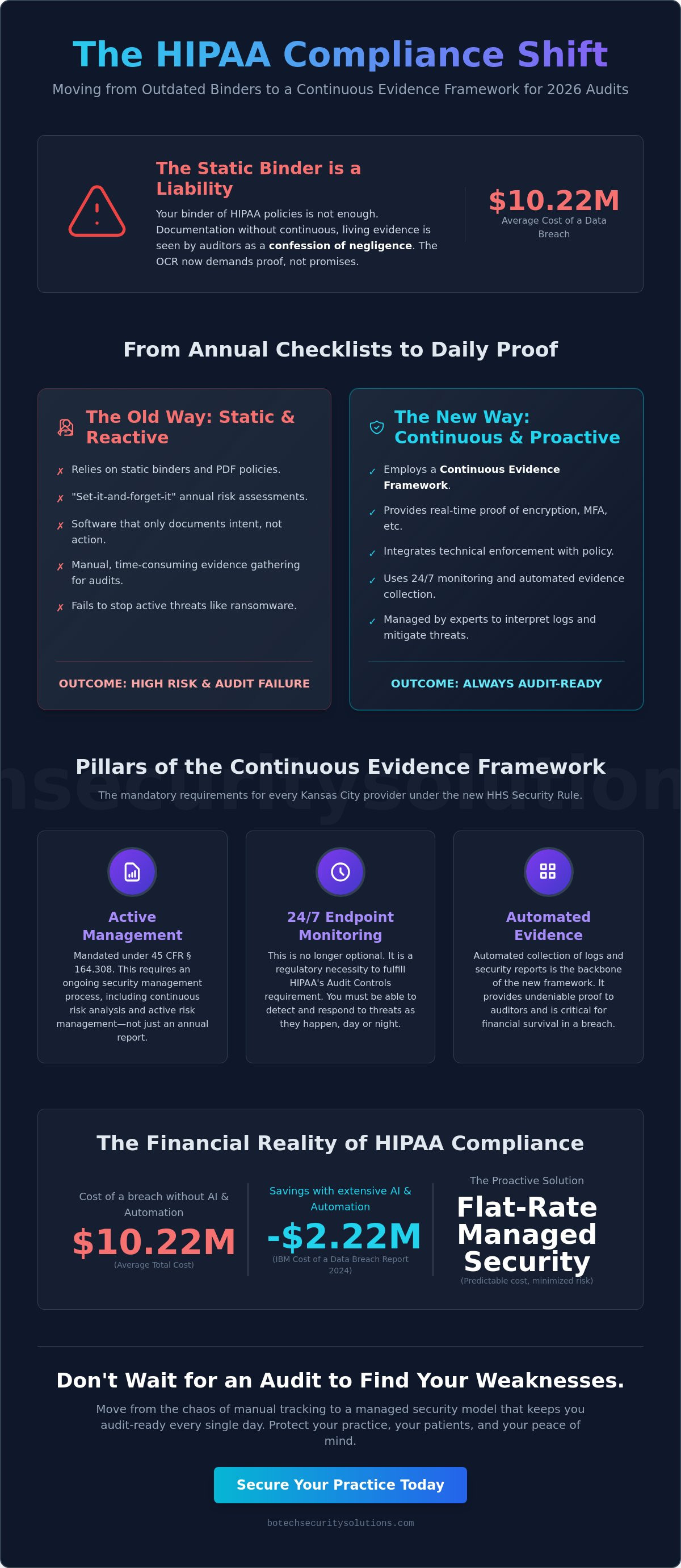
The three ring binder of HIPAA policies sitting on your shelf isn't just outdated; it's a liability. Most practice managers believe that having a written plan is enough to satisfy an auditor, but the reality is that documentation without evidence is a confession of negligence. As the HHS finalizes the first major Security Rule overhaul since 2013, the margin for error has disappeared. You need a hipaa compliance solution that does more than check a box. It must generate the continuous proof of encryption, MFA, and network segmentation that the OCR now demands.
You've likely felt the weight of managing endless Business Associate Agreements while staring down the barrel of a $10.22 million average data breach cost. It's exhausting to keep up with annual penetration tests and biannual scans while actually trying to run a medical practice. We agree that the Security Rule has become a full-time job you didn't sign up for. This article reveals why the addressable safeguards of the past are now mandatory requirements for every Kansas City provider. You'll discover how to move from the chaos of manual tracking to a flat rate, managed security model that keeps you audit-ready every single day.
Key Takeaways
- Learn why a static binder is a liability and how a true hipaa compliance solution must integrate technical enforcement with administrative strategy.
- Understand the shift toward the "Continuous Evidence Framework," which replaces annual checklists with real-time proof of security for 2026 audits.
- Discover why 24/7 endpoint monitoring is no longer optional but a regulatory necessity to fulfill HIPAA’s Audit Controls requirement.
- Use our 5-step framework to determine if your practice has the internal bandwidth to manage compliance software or if you need a managed partner.
- See how a flat-rate managed model provides Kansas City practices with enterprise-grade protection without the overhead of an in-house security team.
The HIPAA Compliance Solution Myth: Why Software Alone Fails Audits
Many Kansas City practice managers believe that buying a subscription to a compliance portal is a complete hipaa compliance solution. This is a dangerous misconception. A true solution is a managed system of technical, physical, and administrative safeguards that work in concert. While software can organize your Business Associate Agreements, it cannot monitor your network for unauthorized access or respond to a late-night brute force attack. You're left with a digital paperweight that documents your intentions but fails to protect your data.
The Health Insurance Portability and Accountability Act (HIPAA) requires active management under 45 CFR § 164.308. This section mandates a security management process that includes risk analysis and risk management. Most vendors sell you a digital filing cabinet and call it compliance. The uncomfortable truth is that software collects data, but it doesn't execute a security strategy. Without a human expert to interpret logs and mitigate threats, your software is just an expensive witness to your practice's downfall.
To better understand what is actually required for compliance training and management, watch this helpful breakdown:
The Danger of the Set-It-and-Forget-It Mindset
Annual risk assessments were sufficient a decade ago, but they are a liability in the 2026 threat environment. Consider a scenario where a mid-sized Kansas City clinic uses a popular compliance tool to track their policies. An employee clicks a phishing link on a Tuesday afternoon. The software records that the employee completed their training, but it does nothing to stop the active ransomware encryption event that follows. By Friday, the clinic is locked out of their EHR and facing a recovery cost that could reach millions.
The Office for Civil Rights (OCR) looks for a "good faith effort" during an audit. As of January 2026, the OCR has settled or imposed civil monetary penalties in more than 50 HIPAA violation cases under its recent initiatives (Source: HHS). These settlements often highlight a failure to conduct a thorough risk analysis or a lack of active monitoring. Compliance isn't a snapshot in time; it is a continuous state of vigilance that software alone cannot provide.
Static Documentation vs. Living Evidence
A compliance document is a promise you make to the government. Living evidence is the proof that you kept that promise. Static binders and PDF policies tell an auditor what you intended to do. Living evidence, such as real-time logs and vulnerability reports, shows what actually happened on your network. To maintain this level of proof, many organizations rely on managed it services kansas city to bridge the gap between policy and practice. You either have the evidence to prove your security controls were active, or you have a document that says you wish they were. In 2026, regulators don't care about your wishes.
Moving Beyond Checklists: The Continuous Evidence Framework
The checklist is a relic of 20th-century compliance. In 2026, a static list of to-do items won't survive a professional audit or a sophisticated ransomware attack. You need a Continuous Evidence Framework. This approach shifts your focus from proving you have a policy to proving that your policy is working every minute of every day. Implementing a modern hipaa compliance solution means your data is secured by active protocols, not just a dusty binder.
Automated evidence collection is the backbone of this strategy. It ensures that when an auditor asks for proof of your 2026 access logs, you aren't scrambling through old emails. Automation isn't just about convenience; it's about financial survival. According to the IBM Cost of a Data Breach Report 2024, organizations that used extensive AI and security automation saved an average of $2.22 million in breach costs compared to those that didn't. This framework is non-negotiable for organizations like law firms and financial advisors, where the cost of non-compliance is simply too great.
Automating the Administrative Burden
Managing Business Associate Agreements (BAAs) is a nightmare for most office managers. You sign a contract with a cloud vendor and forget about it. However, the HIPAA Security Rule requires you to ensure these partners maintain their own security standards. A managed partner handles this vendor discovery and monitoring for you. We provide compliance services that turn administrative chores into automated reports. This allows you to focus on your clients while we handle the paper trail.
The Technical Safeguards Most Small Practices Miss
Most small practices think their backups are working because a piece of software says "Success." Most are not. Without regular backup validation, a backup is just a theory. You must prove you can restore data within the 72-hour window mandated by the 2026 updates. Patch management is another critical gap. Hackers exploit known vulnerabilities faster than you can manually update your servers. Understanding common cyber attacks helps you realize why these technical safeguards are non-negotiable. If you're unsure if your current systems are actually generating this evidence, you can reach out for a quick sanity check. A robust hipaa compliance solution provides the peace of mind that your data is protected by active, verified protocols.
The Critical Role of 24/7 Managed Detection in HIPAA Security
You can't comply with what you can't see. The HIPAA Security Rule, specifically 45 CFR § 164.312(b), requires covered entities to implement hardware, software, or procedural mechanisms that record and examine activity in information systems. Standard antivirus is not a hipaa compliance solution. It's a reactive tool that waits for a known threat to arrive, which is useless against the zero-day exploits currently targeting Kansas City practices.
A true managed security partner provides Managed Detection and Response (MDR) to fulfill these audit control requirements. At BoTech Security Solutions, we operate as veteran-owned Vigilant Guardians for your data. We don't just install software and walk away; we take proactive ownership of your network's integrity. This level of oversight follows the HIPAA Security Rule guidance on risk management by ensuring threats are hunted, not just reported.
Why Endpoint Protection is the Front Line
Modern breaches rarely happen all at once. An attacker typically gains access to a single workstation and then moves laterally through your network to find the server containing ePHI. MDR monitors these behavioral shifts in real-time to stop an intruder before they reach your most sensitive records. Most are not protected; they are merely hopeful.
This constant surveillance also provides the forensic logs necessary after a potential incident. In February 2026 alone, 63 healthcare data breaches affecting 500 or more individuals were reported to the HHS (Source: HHS). If your practice is investigated, the OCR will demand proof of what happened and when. Without 24/7 monitoring, you'll have no evidence to defend your actions or prove that a breach was contained.
Managed Security vs. Managed IT
There is a massive difference between a helpdesk that fixes your printer and a security partner that hunts for hackers. Traditional IT is built for convenience and uptime, while managed security is built for protection and compliance. Your managed it support must be security-led to survive an audit. If your IT provider isn't talking about threat hunting, they aren't providing a hipaa compliance solution.
We provide enterprise-grade protection using a flat-rate model that fits a small business budget. This approach removes the financial unpredictability of cybersecurity while ensuring you have the same tools used by billion-dollar hospital systems. You get the peace of mind of 24/7 vigilance without the overhead of an in-house Security Operations Center. It's about moving from the anxiety of the unknown to the organized calm of a secure environment.
Evaluating Your Options: Software vs. Managed Security Partners
Choosing a hipaa compliance solution is a high stakes decision that most Kansas City firms get wrong by focusing on the price of a subscription rather than the cost of a breach. Software is a tool, not a strategy. If you buy a dashboard but don't have a security expert to drive it, you've simply purchased an expensive way to watch your data disappear. You need a framework that separates digital paperweights from real protection.
The first step in this evaluation is determining if you have the internal bandwidth to manage software alerts. Most office managers don't have the technical expertise to investigate a security warning at 2 AM. Second, you must verify if the solution includes active 24/7 incident response or if it simply notes the incident for later review. Third, check for local expertise and onsite support capabilities within the Kansas City area. Fourth, ensure the solution addresses the technical requirements of the Security Rule rather than just providing Privacy Rule paperwork. Finally, demand a system that generates ongoing evidence rather than static documents.
The Hidden Costs of DIY Compliance Software
Alert fatigue is the silent killer of small business security. When a compliance portal sends fifty notifications a day, busy professionals eventually ignore them. This is how critical vulnerabilities are missed. Mid-sized organizations can expect to spend between $30,000 and $120,000 annually on HIPAA compliance in 2026 (Source: Industry Research). Trying to save money with a DIY software approach often results in hiring a dedicated compliance officer, which costs far more than a managed partnership. We act as the One partner solution, consolidating security monitoring and compliance management into a single, predictable relationship.
Questions to Ask Your Current IT Provider
Most IT providers claim they are compliant, but few can prove it. You need to test their competency with direct questions that focus on evidence. Ask them if they can show you the last 30 days of endpoint logs for your PHI accessible devices. If they hesitate or point to a generic backup report, they aren't managing your security. Most are not able to provide this evidence on demand because they lack the proper hipaa compliance solution architecture. You can use our ai governance strategic visibility checklist to further evaluate how your technology stack aligns with modern regulatory standards. If your current provider can't provide live evidence of protection, it is time to schedule a consultation to find where you actually stand.
The BoTech Approach: Enterprise HIPAA Security for KC Practices
Small businesses often feel trapped between expensive enterprise tools and ineffective consumer software. We built BoTech to end that compromise. Our hipaa compliance solution provides the same 24/7 Managed Detection and Response used by major health systems but at a predictable, flat monthly rate. You don't need another software subscription; you need a strategic ally that takes ownership of your security posture.
Being based in Kansas City gives us a distinct advantage. We understand the specific regulatory pressures facing local clinics and law firms. Organizations That Cannot Afford to Get This Wrong need a partner who can show up onsite to validate physical safeguards or hardware encryption. We provide the tough love honesty required to move you from complacency to a state of secure partnership.
One Partner for Security and Compliance
We consolidate your MDR, email security, and compliance management into a single managed service. This One partner approach eliminates the finger-pointing that happens when multiple vendors are involved in a breach. Our military veteran-led team operates with disciplined vigilance to ensure your practice remains audit-ready. You can explore our resources for deeper insights into how we bridge the gap between technical security and administrative compliance.
Actionable Step: The HIPAA Gap Analysis
You can find your own vulnerabilities today with a simple self-check. Open your Business Associate Agreement folder and verify that every vendor has a signed contract dated within the last two years. Then, look at your backup logs and find the last time a full restore was successfully validated. The uncomfortable truth is that most practices find missing signatures and failed restore attempts they never noticed. Identifying these gaps is the first step toward true protection.
Stop guessing about your security posture and start knowing. Find out where you actually stand with a free assessment. We'll help you identify the gaps in your current framework and show you how a managed hipaa compliance solution can secure your practice for 2026 and beyond.
Securing Your Practice for the 2026 Regulatory Shift
The 2026 regulatory shift has made one thing clear: intent is no longer enough to satisfy an auditor. You need a hipaa compliance solution that generates constant, verifiable proof of your security controls. Relying on a static binder or unmonitored software leaves you vulnerable to the $10.22 million average cost of a healthcare breach (Source: HHS 2026). Audit readiness is now a continuous technical requirement, not an annual administrative task.
As a veteran-owned and operated firm specialized in the Kansas City healthcare and legal sectors, we provide the enterprise-grade 24/7 MDR required to hunt threats before they become disasters. We deliver this protection through a predictable flat monthly rate that eliminates the financial chaos of cybersecurity. You shouldn't have to choose between practice affordability and data survival. Our team acts as your vigilant guardian, ensuring your safeguards are active every hour of the day.
It is time to move from the anxiety of the unknown to the organized calm of a truly secure environment. Find out where you actually stand; Schedule your free HIPAA assessment. We are ready to act as your strategic ally and protect the organization you've built.
Frequently Asked Questions
What is the difference between HIPAA compliant software and a HIPAA compliance solution?
Software is a digital filing cabinet for your policies; a hipaa compliance solution is a managed system of technical and administrative enforcement. Software helps you organize documents, but it cannot stop a hacker or monitor your logs. You need a partner who executes the security strategy and generates the evidence required by 45 CFR § 164.308. Most are not protected by software alone; they are merely organized.
Does HIPAA compliance software guarantee I will pass an audit?
No software can guarantee an audit pass because the OCR evaluates your active management, not just your tools. Auditors look for a "good faith effort" through consistent risk mitigation and incident response logs. If your software flagged a vulnerability six months ago and no one fixed it, the software becomes evidence of your neglect rather than your compliance. You must prove the safeguards were actually working.
How much does a managed HIPAA compliance solution cost for a small practice?
While specific costs vary by seat count, mid-sized organizations typically spend between $30,000 and $120,000 annually on compliance activities in 2026 (Source: Industry Research). Software subscriptions often range from $299 to $600 per month. A managed hipaa compliance solution consolidates these costs into a flat rate that includes both the technology and the expert labor required to interpret alerts and remediate threats.
Can a small medical practice manage HIPAA compliance without an external partner?
It is possible but increasingly dangerous due to the 2026 Security Rule updates. These changes have eliminated many "addressable" safeguards, making complex technical controls like MFA and network segmentation mandatory for everyone. Most office managers lack the 24/7 bandwidth required to hunt for lateral movement or validate backups every single day. One partner can handle these complexities while you focus on patient care.
What happens if our practice is audited by the OCR and we only have basic antivirus?
You will likely face Tier 2 or Tier 3 penalties for "reasonable cause" or "willful neglect." As of January 2026, Tier 2 fines start at $1,461 per violation, while Tier 3 fines for uncorrected neglect reach $73,011 (Source: HHS). Basic antivirus does not meet the "Audit Controls" requirement of 45 CFR § 164.312(b), leaving you without the forensic logs needed during an investigation.
Is email encryption enough to be considered HIPAA compliant?
Encryption is only one piece of the puzzle. While 45 CFR § 164.312 requires ePHI to be protected in transit, you must also implement access controls, device security, and employee training. Compliance is a holistic framework. If your email is encrypted but your workstations lack Multi-Factor Authentication, you are still in violation of the updated Security Rule mandates that went into effect in 2026.
How does 24/7 MDR help with HIPAA Security Rule requirements?
Managed Detection and Response (MDR) fulfills the technical requirement for continuous monitoring and audit logs. It records every action on your network, providing the "living evidence" that auditors demand. This proactive hunting ensures you can demonstrate a 72 hour system restoration capability, which is a verified requirement for the 2026 compliance cycle. It moves your practice from a reactive posture to proactive protection.
Why do Kansas City law firms need to worry about HIPAA compliance?
Law firms handling medical records or personal injury cases are classified as Business Associates. Under the HITECH Act, Business Associates are directly liable for compliance with the HIPAA Security Rule. A single data breach could lead to OCR fines and state attorney general penalties of up to $25,000 per violation category per year (Source: HHS). Firms that cannot afford to get this wrong must treat ePHI with enterprise-grade security.